**As an Amazon Associate I earn from qualifying purchases**
In August 2022, I went with my manager and another colleague on a very small nature based retreat run by Occupational Therapists. We flew out to Chicago and met 20 other OTs who utilize nature in their practice, and spent the weekend sharing stories and teaching each other.
One of the OTs brought up Interoception, something I had never heard about. They shared that Interoception is the sense of signals that come from inside your body, such as feeling your heart beating and your breathing, or knowing when you are hungry. Interoception is one of our senses, like vision, hearing, taste, smell, and touch, but we often don’t focus on this sense when we are working with our clients.
I became absolutely obsessed with this concept because I felt like I was missing such an important factor! I’m 30 years old and it was only recently that I realized I don’t notice hunger very well and that it leads to HANGER or HANXIETY (according to my wife) if I don’t eat regularly. So I got every book I could get my hands on… but I honestly haven’t read many because I’m such a slow reader!
This book however, written by Cara N Koscinski, was wonderful! It talks about the importance of working with interoception as an OT and recognizing that lack of internal awareness can play a huge role in many of the goals our clients are working towards!

Link to book here : https://amzn.to/47PWcbI
I loved that this was a book that mixed science within the conversation, in a digestible way that I could enjoy without feeling unsure I understood. She talks about the need for internal recognition to recognize and manage emotions, learning new things, participating in social emotional connections etc. She also includes activity suggestions for the different senses and how you can modify them for older or younger children/abilities! I love when books give a tangible way to utilize the knowledge they’re providing so that you can actually use the knowledge as soon as possible. Something else I loved about the book was it’s easy language. You didn’t need to be a PHD holder to understand and use what you’re reading, which allows families to use it as well as professionals.
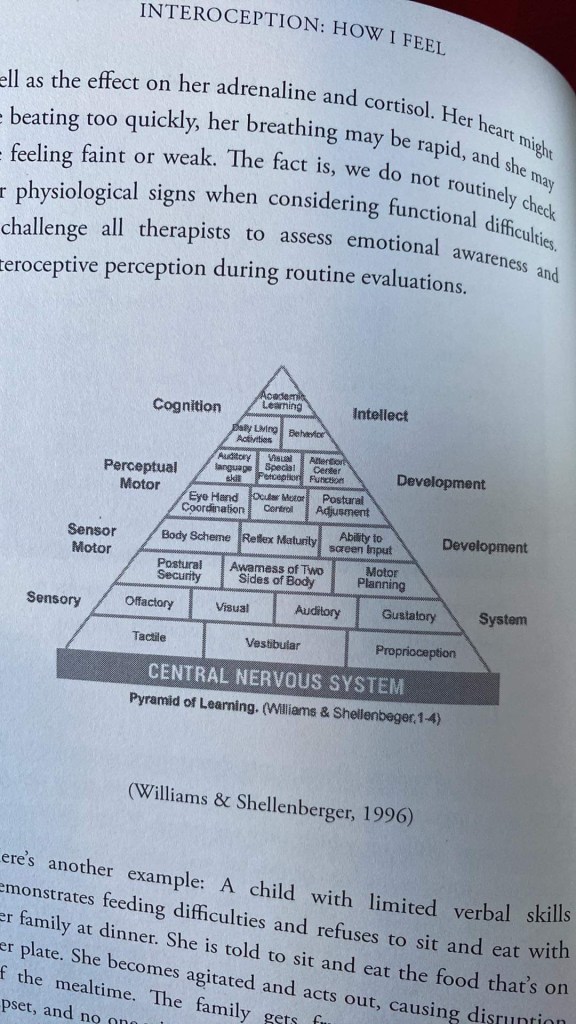
I also felt validated and comforted that although I haven’t yet explored interoception with clients deeply, I do use the concept in my practice! One of the examples she used was using the skill pyramid (see photo above) to explore what skills the client needs to focus on. She related this to handwriting, and how often we focus on lack of fine motor skills, physical hand strength, posture etc… but often we miss that perhaps our child is experiencing fast heart rates, unsettled belly, feeling weak or faint in relation to anxiety. Reading this made me realize I HAVE been using this concept in the background of sessions to assess where to go next! Most of my handwriting clients won’t even pick up a pencil in my sessions when we start and after some gentle exploration and non writing activities, we come to realize together that they’re nervous about making a mistake or looking stupid. We then will focus on FEELING safe with writing, but I didn’t connect that this might actually be a skill to work on that is researched!
As a trauma informed therapist, I like to focus on the emotionally safe aspect, but school didn’t teach that. I have been self doubting and feeling imposter syndrome for so long with certain skills, and this book made me reconsider that! We are often made to feel, from school as well as regulatory bodies and work police’s, that if we don’t see fast measurable results we aren’t doing our jobs, but meeting a client where they are at so they can properly learn is key.
Taking the time to remember the purpose of OT as a professional to enable our clients to feel meaning and purpose in life, and live a good quality of life, connects well with focusing on the hierarchy of needs and creating a safe space for our clients. Being able to create that safety allows our clients to learn to notice their own needs and read their emotional signals internally so that eventually they won’t need an outside person to read their external signals.
A lot of the activities and suggestions come with play and simple things you can build into your larger sessions with your clients, as well as teach parents and teachers how to model and provide language. This is my new soap box and new learning theme for the next WHILE and I will continue to read and learn and change for my clients ❤️
I definitely recommend reading this one!
Are you informed about interoception? What are the resources you have used before or heard of? Do you have any go to activities or interventions for interoception with your clients?
 Be Your Own Sunshine