Your alarm goes off Monday morning and you throw off your blankets and start to get ready for the day. You brush your teeth, use the washroom and make your bed. You get dressed, make your breakfast, organize your lunch, pack your bag and head out the door to work. You navigate the busy road as you drive, take deep breaths while you’re cut off by a pick up truck and you make it to work on time. Throughout the day you navigate challenging tasks, problem solve through road blocks and complete your projects of the day before heading home to make dinner and get to the gym.
This sounds like a pretty easy day, and is one where the person living this life is not struggling with any executive functioning skills. If you read this paragraph and thought “yeah right” or “must be nice” about any of it, maybe you are experiencing challenges with executive functioning! As an occupational therapist working with neurodiverse folks, executive functioning is an area of challenge for many of my clients and comes up very frequently. Having challenges with executive functioning DOES NOT mean you are neurodiverse, but it is more common amongst neurodiverse folks.
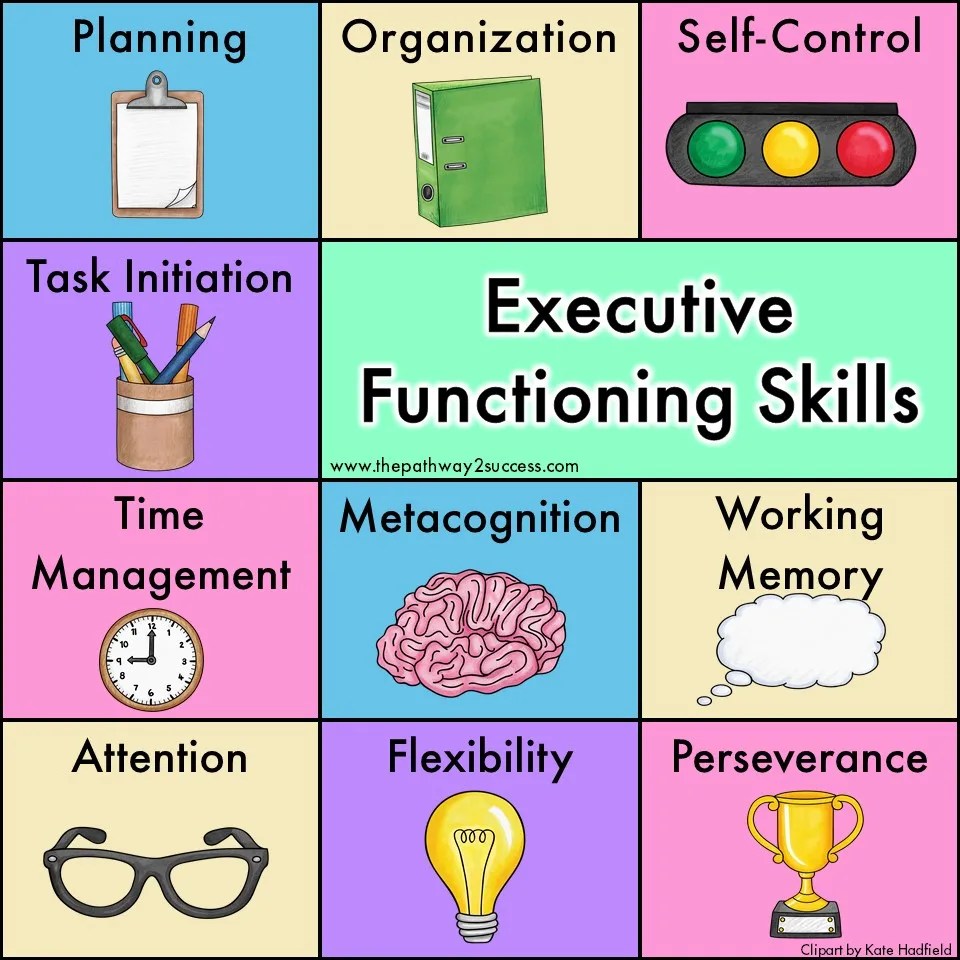
what is executive functioning?
Executive function skills are a set of processes that supports management of your day. These skills enable you to plan, organize, focus attention and juggle multiple tasks so that you can complete the things you want to do and need to do throughout the day. There are many different executive functioning skills expanded on below;
Shifting – moving from one situation or task to another and having flexibility in change throughout the day. If you have children or work with children you may be familiar with the word “transition” being thrown around, where kids often have a hard time with shifting or transitioning between activities.
Emotional control – managing your feelings, looking at size of emotional responses related to problems. It is important to note that you are not MUTING your feelings, it is ok to be upset or feel hard emotions, this is more about how to work through these harder emotions if you are having them.
Working memory – retaining and remembering information that you previously learned. Working memory involves information you would need to call upon from previous experiences in order to be able to do something. For example; if you learned how to build an Ikea dresser and realized you should have had a specific tool and then had to go out and get one, your working memory would remind you the next time you have to build an Ikea item that you should bring this tool just in case.
Planning – being able to create a road map for a task so that you know how you are going to complete something or work through challenges if they arise. For example; maybe you recognize that a similar project took 3 weeks previously to complete so you try to give yourself 3 weeks at least to complete your project and this also may account for if challenges come up you need to fix
Organization – being able to create a system to keep track of materials or everyday items. Perhaps you are putting things in a specific “home” to be able to find them so that when you need them right away they are there.
Response inhibition – controlling our impulses, think before we react. This relates to emotional control but instead of managing your emotions, you are managing your reactions and behaviours in a situation. Response inhibition is the skill of being able to stop in a situation, observe what is happening and modulate our behaviours appropriately.
Task initiation – Exactly as it sounds, task initiation is starting a task. Often for some people this is simple, others may be slow to start a task or need to actively avoid distractions to start successfully. Important to note this is not simply procrastination.
Sustained attention – staying on task fully through to completion, getting things done even with appealing distractions.
Time management – estimating how long it takes to do something so that you can plan appropriately. Often takes into account what you want to do and need to do, what others ask us to do and managing prioritization.
Metacognition – This is our life lesson machine, our ability to reflect on past actions and behaviours to make informed decisions for future situations. This is a higher cognitive level of thinking where we need to look at what we did and why and figuring out what to do next time.
What happens when theres challenges with Executive functioning?
If someone experiences challenges with executive functioning, there is a good chance that the activities you are trying to do throughout the day become a challenge. Often clients will express frustration in our sessions that despite really wanting to do something they can’t do it. They may experience challenges with starting a task, with organizing and planning and then carrying out the plan. It may become difficult to remember certain parts of a task or what you should be doing in this moment. There may be increased distractibility which becomes more of a challenge if switching your attention between tasks is a challenge.
In summary, you may feel like even the activities you really love and want to do are hard to do. And in extension, this often comes with feelings of guilt, shame, laziness, brokenness. You may experience frustration with yourself for not being able to follow through with an activity that is classified as relatively simple in society, and feel frustration with others when they ask why you can’t “just do it”.
It is important to remember that often times if you are experiencing challenges with your executive functioning skills, you may be using more cognitive energy to engage in a task that may be relatively easy for someone else. For example, if you are trying to make yourself dinner, the energy it may take for you may be larger than others because of the extra consideration you have to work through. It may take more energy to plan out what you have in the fridge, what you can make, what the steps are, preparing all the food to cook, cooking the food, cleaning up after and the anticipation of how long that might take. You may have a hard time keeping on track and remembering steps or ingredients. Maybe you have other things that are taking your attention so you keep having to intentionally return to cooking – that is a lot of energy spent on task switching! You may experience feelings you have to regulate around frustration with time management, memory or constant distractions. So at the end of the day, “just making a meal” becomes so much more energy and next time you need to make a meal you may have a harder time initiating the task in anticipation of this exhaustion.
What can you do?
You can try to work through this on your own by reading and researching, or you could find a therapist or an occupational therapist who is familiar with executive functioning challenges. As you figure out what executive skills may be challenging for you, compensatory strategies to support when you are struggling would be helpful – we are not looking to “fix” but to accommodate. You may , for example, take to writing things down more to help with memory or simplifying a task to make it easier to plan, start and follow through. In sessions with my clients I often also focus on self awareness acceptance and self compassion. It is easy to find a problem and look for a solution, but what happens when the solution doesn’t always work or fix things back to “normal”. It is important to note that sometimes you may have an easier time with a task vs others depending on your energy levels, focus, mental health etc, so learning to be aware of what happens when you are having more challenges and what you can do about it can be helpful (building that metacognition and problem solving skill).
It is also important to be able to work on being kind to yourself when things are harder and remind yourself that you are not lazy or broken for having a harder time than other people. Working to shift your perspective to being kinder to yourself and treating yourself with compassion can be a hard part but can be very game changing for the way you approach and accept your life
At the end of the day, as you are on your journey of self learning and self acceptance, remember you are not alone and you are not lazy for having a hard time with tasks that may “seem simple”. If you have more questions feel free to comment below for future blog posts

