As a neurodiverse affirming occupational therapist, I work very hard to meet my clients where they are at and to honour their needs and autonomy. I come to you with a blog title in the format of declarative language, one form of communication that is helpful for folks with PDA. Declarative language is a communication style that shares information and invites others to respond. It can be used to share feelings, describe observations, or make comment. It is a way to invite curiosity and engagement, as I hope to invite you to explore PDA with me.
What is Pathological Demand Avoidance (aka PDA)
PDA is terminology used to describe a neurotype which co-occurs with Autism Spectrum Disorder that results in a pattern of behaviour in which real or perceived loss of autonomy leads to an extreme stress response. This is a label that is not officially recognized as a diagnosis in North America in the DSM, but is starting to be more recognized by therapists and families. PDA looks at “oppositional behaviours” from the lens of a nervous system disability, rather than willful behaviour. An alternative name using a neurodiversity affirming reframe is “Pervasive Drive for Autonomy”
“PDA individuals avoid everyday demands using ‘social strategies’ as part of the avoidance, have a strong need for autonomy and control, require unique supports and are socially oriented. These highly stress-prone individuals are often not recognized as autistic, are deeply misunderstood and in need of support.” https://pdanorthamerica.org/what-is-pda/

I wanted to write a post about PDA because it can be very challenging to understand for someone who does not experience these nervous system differences. It can be extremely overwhelming to live with PDA or support someone with PDA because our society is not built in a way that is accommodating for PDA-ers. There are constantly external demands being placed on us, but also societal norms which increase our beliefs in what we “should” be doing and who we “should” be.
In this post I have tried to add a couple quotes and pages from the book I am currently reading – PDA by PDAers by Sally Cat. I haven’t made my way completely through the book yet, so there will probably be more posts to come, but for now let’s dive into some shallow waters together.
What does PDA look like?
Something that is important to note is that individuals who have PDA may be extremely anxious when it comes to demands, but this can very much change in the way it looks from day to day depending on the situation. Depending on the state of the person’s nervous system and their level of burnout, they may be more triggered by even the basic demands.

A quote from PDA by PDA-ers shares ; “Due to the added anxiety that comes with PDA, PDA people will feel that nearly everything is a demand. Work, family, friends, school, housework etc may be at the top of the demand pile.”
Often these demands can be being told to do certain things, but could also be an expectation of something you have to do such as going to work or cooking a meal. This can make life challenging as often things you need to do are demands. PDA-ers can also experience internal demands, which could be things such as feeling you need to eat, the expectations to meet social norms, or the expectation of being perfect.
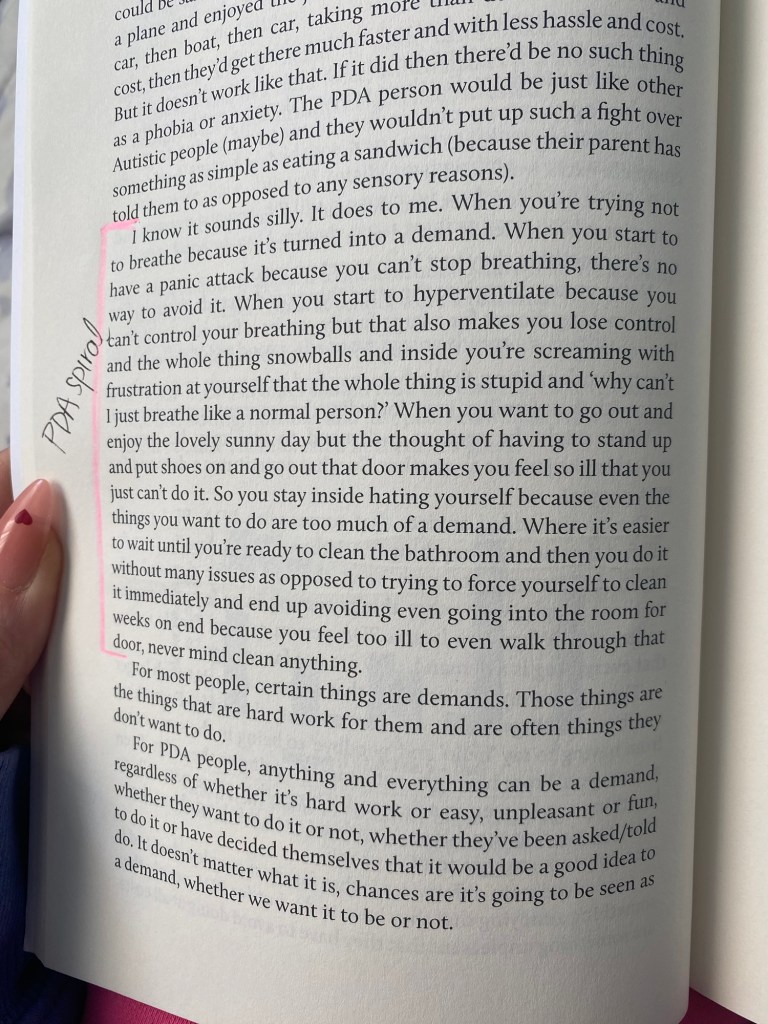
If an individual becomes overwhelmed or is more burntout, they may become more sensitive to demands and feel heightened anxiety over more basic needs. It is important to remember that autistic burnout is not necessarily being overworked. It could be triggered by heightened demands, being unable to unmask enough to find time to regulate your nervous system, etc.
With one of my clients, I connected with a colleague about her inability to sleep and then wake up in the morning. She had already been struggling with attending school and other programming, and it seemed that things were getting worse. My colleague, who works predominantly with children and teenagers with PDA, shared that often if burnout becomes too much, even the most basic need can become a demand that causes extreme anxiety – the passage from the book above describes this idea perfectly.
So what might PDA look like?
Equalizing – Trying to gain back control in a situation where there is a perceived loss of control (i.e. with an parent/teacher/therapist, an older/NT sibling, in a classroom, etc.) Equalizing behaviors can manifest in various ways depending on the individual, including controlling or defiant behaviors, or even internally as self-harm, eating disorders, or OCD-like behaviors. Examples could be; a child knocking down their sibling’s toys after being told to clean them up, a child saying something rude to a parent after being asked to do something, a person constantly changing the words or tone of a song or story being read to them.
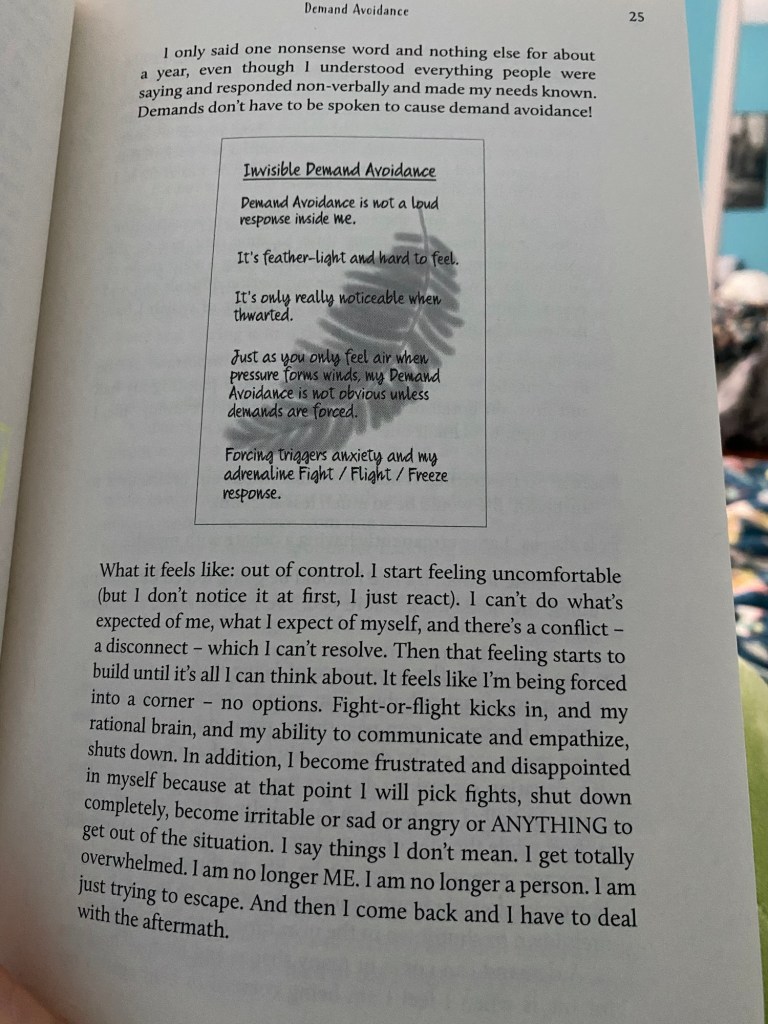
Fight/Flight regarding demands – Significant dysregulation (fight/flight/freeze) as a nervous system response to real or perceived demands – either imposed by others or self. Often these responses can seem like they will come out of no where when observed/experienced by someone who is part of the scenario, but this is because demands can often be invisible to other parties. If someone is experiencing tons of anxiety around expectations, social norms, etc and then one demand is placed on them that is the “straw on the camel’s back” this could look like they are randomly explosive, but in fact there is a lot more going on for the PDA-er.
Frequent Burnout – Nervous system dysregulation builds up over time and often leads to autistic burnout – a prolonged state of intense fatigue related to chronic nervous system stress. This burnout often lasts for a variable period of time depending on how dysregulated someone has become and how much energy they can put into repairing this burnout. Often times accommodations and modifications are necessary in order to come back from burnout. One of my clients has needed all external demands removed from their world and has been in this burnout state for months. They are not attending school and additional programs, need support with basic needs and are not sleeping well. Many of my clients have a hard time with self care activities like brushing hair and teeth, and they need help finding creative ways to manage.

How to support someone using a PDA lens
Before diving into supporting someone with PDA, let’s talk about supporting someone who is neurodiverse. When I am teaching my placement students about how to support their clients, we talk about strengths based approaches, neurodiverse affirming strategies and the “follow the child” mentality.
In general, these three buzzphrases I use are to direct you to be an empathetic individual and to meet the person where they are in the moment. For example, if one of my clients show up to day program feeling very low energy or anxious, I may change my expectations of their engagement during the time we have together. Maybe we change an activity or I provide more accommodations than in other sessions. Maybe they need to take more of the control of the session (follow the child/client) as they direct you to what they want to talk about or what they want to play and you try to incorporate some learning in these moments IF it seems appropriate and that you won’t push them away.
PDA adds on another aspect to considerations of how to connect. Here are a few:

Set Low Demands – Placing low-to-no demands as much as possible to support more consistent nervous system regulation – i.e. removing demands for daily hygiene, household expectations, etc. This can be challenging sometimes as not only may these demands be beneficial to them, but society sees these as important to function. Something to note is that these low demands are going to shift based on a large number of things. For example, we talked about burnout previously – if an individual is in full functioning energy (for them), they may seem to thrive at school, be able to manage their basic needs and can join programs and engage in hobbies they enjoy. If they are moving towards or are in burnout phase, even things they like to do may be a demand. So in these cases, lowering demands might even effect things like sleep routines, hygiene modifications and mealtimes.
Providing Control – Providing choice and control as much as possible (outside of necessary safety boundaries, etc.). When I am working with my clients I have non negotiables that can’t be changed, and then have ways in my head that I know I can work towards our goals while giving my clients the most control possible. For example, since I work outside on an enclosed property, I know there are certain areas of the property that I can let my clients roam on their own if they need space, where they will be safe. If they are getting upset and need to take control of their space, I have physical boundaries where they can’t go but I will tell them if they stay out of that space they can go where they want. I also will often bring bags full of carefully chosen activities to in home sessions, and then lay everything out so that the clients feel in control of what they choose. I like to think I have gotten quite good at being able to curate bags of activities that will meet our goals regardless of the choices my clients make! Gives them autonomy over our time together!
Recovery time – Prioritizing recovery time/downtime proactively to allow the child to replenish their tolerance for school/social/family activities, before burnout occurs. This can be a challenging one to explore because there are so many expectations in society about productivity. As an Occupational therapist, if I don’t check off a bunch of boxes every second sometimes I feel like I’m not doing enough. As a parent, comparison is so tough to navigate as if you are not keeping up with the successes of other parents you can often run into the feeling of shame. Practicing giving yourself, your clients, your children recovery time in sessions, after school, on the weekends etc can be challenging as it goes against “hustle culture” that we have in the western countries, but it can be a game changer to help maintain connection and engagement and preventing burnout. Remember it is always easier to maintain energy and regulation than having to repair it!
Please keep in mind this was a very short sharing about PDA that I have been thinking about for a while. There are so many things to learn and so many strategies that I feel I use every day with my clients that I haven’t been able to write out. For now, I hope this opens your eyes to the world of PDA and gives you a place to start and get curious!
Feel free to comment about your experience or your questions and I can try to collect more information from the resources I’m exploring as well as my colleagues who are also on this journey with me 🙂 Thank you for learning!
Resources :
At Peace Parenting https://www.atpeaceparents.com

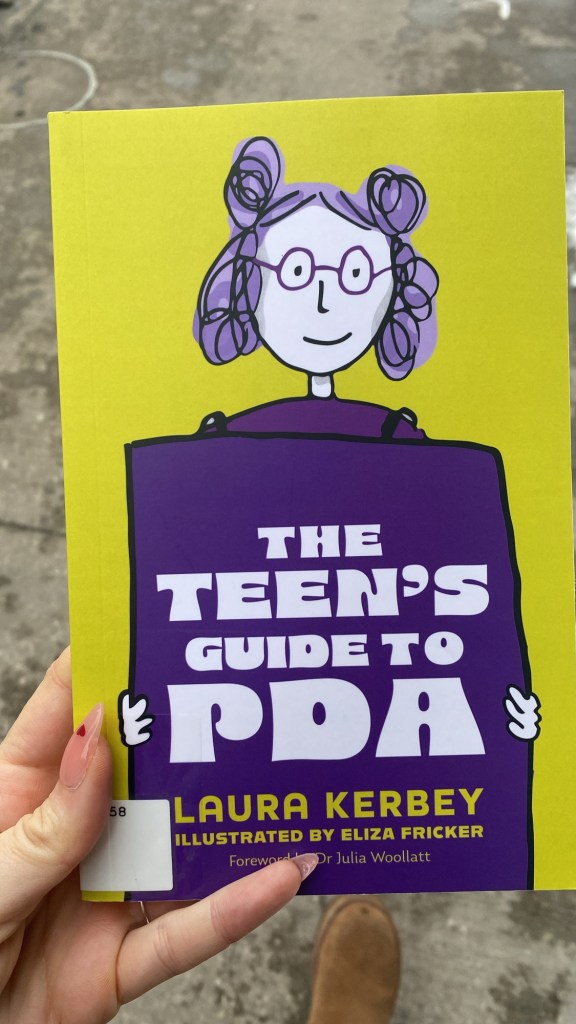
The Teen’s Guide To PDA by Laura Kerbey
PDA by PDAers – Compiled by Sally Cat
PDA Society – https://www.pdasociety.org.uk
Cherish Clinic – https://cherishclinic.notion.site
 Be Your Own Sunshine
One thought on “I wonder if you’re curious about Pathological Demand Avoidance?”