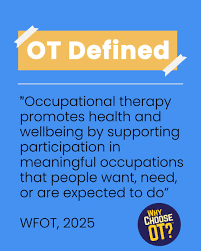
Occupational therapy (OT) is the practice of supporting and empowering your clients to be able to do what they need to do, want to do and are expected to do. If you have just recently graduated from your OT degree, you probably have had that drilled in your head over and over. The thing that is not typically taught is that sometimes clients don’t lack the skills to do the task itself, but there is some sort of barrier to accessing the occupation that needs to be addressed. OTs are educated to look at the barrier of the person (skills), occupation (challenge of the activity), and environment (accessibility), but what if the barrier is deeper?

Occupations are defined as activities that we need to do, want to do or are expected to do.. our activities of daily living. For adults that might look like working, maintaining a household, taking care of our bodies, enjoying leisurely activities etc and for kids that may look like attending school, playing, making friends, learning life skills to take care of ourselves as we grow. I work as an OT within the neurodiverse population, and often times I’m sought out to support with living skills such as cleaning your room, washing your dishes, being hygienic etc. In school we were taught to find different ways to teach a life skill or to make sure the client knows the steps, but sometimes the client’s capability to complete the activity is not actually the challenge.
I mentioned access to occupation and barriers in the paragraph above, but what if access to occupation is more internal? When I’m working with my neurodiverse clients, whether they are kids, teens or adults, I always come into the session with the question in my head of “what is the hard thing here”. And for the most part, the hard thing isn’t always the task itself.
Perhaps you’re a school teacher, a parent or you’re around children because a friend or family has them. Consider a situation where the child needs to be moved from one space to another – perhaps leaving a family function, changing activities in class, getting to school in the morning. One common challenge in all of these activities is transition. When I used to work in a daycare as a classroom assistant, the parents would talk about how hard it is to get them to daycare but then they would have so much fun during the day with their friends and then not want to leave. The challenge was not that they didn’t want to be at daycare, it was that it was hard to transition from home to school.
Now think about all the transitions that a child (this applies to a lot of my adults too but let’s stick with kids for the moment) has to do during a school day. It’s time to read a book on the carpet (transition to the carpet), now we’re going to do some drawing (transition to tables), it’s recess time let’s play outside! (get dressed for outdoors), recess is over time to go inside to the library (come inside and put away outdoor things AND go to the library). All of these transitions can be seen as a barrier to participation in the activities that are playing, learning and socializing with friends. But we can’t eliminate transitions completely, they are natural parts of life! So what do we do?
As an OT, I believe it is important to look at the occupations your clients are having a hard time with and expanding your vision to seeing more than the actual occupation itself. What are barriers that could be adding to the challenge of participation? Perhaps your clients have a hard time with transitions, perhaps there are barriers in the environment that make it hard to be part of the occupation, or maybe there is anxiety, low energy levels, executive functioning challenges or heightened fatigue that make engaging difficult. Perhaps your client’s nervous system is so activated that they can’t even start to think about the engagement of an activity.
This is where we have to stop, step back and explore more than capability. If your client does not have the emotional, mental, cognitive or sensory capacity to engage in an activity, they won’t be able to access it no matter how many different strategies you give them. It would be like giving a microphone to someone who is not able to speak – the issue is not that they aren’t able to be heard its that they need to access communication in a different way.
How can you take an access lens vs capability lens?
- Discuss with your client or their care team (family, friends, teachers etc) what they see on a day to day basis. You might do an assessment for your client and luckily got them on a day where they’re feeling good and they seem to have the skill, but there’s a reason their in OT so maybe there are challenges in other environments that need support. Perhaps you are not focusing on teaching a life skills but on strategizing how to do the life skill in a way that best suits the individual
- Consider emotional regulation and mental and physical wellbeing as a contributor to challenges with engagement/participation. I met a child recently while shadowing another OT who refused to participate in session and was sleeping at school all day. They were stumped as to what was happening because even though he has a hard time with participation in school, he usually likes OT sessions. Then I learned he had a big “out of routine” day the previous day, he was sniffling all day indicating allergies or illness, and I also wondered that maybe he was anxious about meeting me. This helped me take a different approach to get him comfortable in the setting and we were able to play a little bit before session was done. If I had just assumed he was choosing to not participate we may not have broken through!
- Meet your clients where they are THAT DAY. In OT school goal progression seems very linear. If you taught a client something one week you’ll be further after a few weeks. But taking that approach neglects the idea that our ability to participate in various occupations can shift day to day based on what we are experiencing that day. Some of my clients have very major anxiety or chronic migraines, and on the harder days, they may not be able to focus enough to participate or their engagement may seem less but it’s not because they aren’t capable! Validating these harder days and finding strategies for the inevitable challenging days is a great pivot in a session like that.
- Focus more on making a safe environment than achieving goals. It seems obvious that you’d want to create a safe space as an OT, but I mean really intentionally doing so. If your client is getting distracted or shutting down because of heightened anxiety, sensory challenges or emotional dysregulation, you may need to intentionally step back, assess what might be comforting and offer this instead. Instead of working on handwriting or practicing a cognitive activity, perhaps you talk about the anxiety, offer sensory tools to help with regulation or do a familiar low demand activity to focus on safe connection. If your client feels safe on a hard day, they’ll be more connected with you and be more eager to engage on a better day.
- Remove the expectation of what a task “SHOULD” look like and work to figure out what it might look like for your individual client. I am a big advocate for looking at the societal construct of different occupations and exploring what an occupation could look like for my specific client. This may seem like extra work in the moment but a lot of the things we do were not made accessible for everyone. I’ll use the example of preparing dinner. For a lot of my adult clients, they have a hard time preparing dinner, not because they can’t use a stove but because there are too many steps for their executive functioning or they have significant fatigue so it’s not possible to cook a big meal at the end of the day. Perhaps their mental health is bad and they can’t get out of bed. So we question what “should” dinner look like and what can it look like for them – maybe they have premade meals they just need to warm up, maybe they grocery shop not for a planned meal prep but for ingredients they could eat easily as a snack board (ex: raw carrots and hummus, cheese and crackers) so that even on a day they can’t prepare something they can eat the food groups. Maybe we’re talking about not having to eat a formal sit down meal like their parents did, but it is a more casual meal with the goal of just feeding themselves which is easier for someone who struggles to follow multistep instructions.
At the end of the day, looking at access takes a lot more thinking and creativity. As one of my clients says, how overwhelming to try to change your perspective on things that other people “just do”, but also how empowering to be able to brainstorm what the true challenge is with your client and being able to create a safe space to find ways to set yourself up for success!
This is the start (hopefully) of more blog posts going in the direction of seeing the world differently, working outside of the box and collaborating with clients to meet them where they are at and create a world they can thrive in
Is there something you do or would like to see be done to add to this list?

