In September, I had the opportunity to explore a new area in my practice!
I am an Occupational therapist that works in a day program with individualized programming for children, teens and adults… aka I am NOT a specialist! I am always trying to learn something new and to expand my knowledge as an OT to best support my clients. In the summer, I was introduced to a client who’s parent wanted him to be exposed to new foods. She called it “feeding therapy”, but as I learned in the nature based OT retreat I went to in August, the food exploration I am talking about is more based in anxiety and sensory strategies vs physical challenges with feeding. I want to make this clear because the tips I’m going to talk about in this post are for hesitant eaters, NOT to be confused with kids who have more challenges around chewing, swallowing etc. These are your kiddos who may not want to try new things, may be sensitive to textures or may only want chicken nuggets (or fill in your child’s focus food) for every meal.

My wonderful OT student in the summer put together 5 tips for hesitant eaters which were based on our discussions and her research! In the past month I have had the opportunity to use these tips in practice further, and to add to my own reflections. Again, as I share these tips, please take into consideration that these are tips to support your child if they are hesitant eaters. This is not a replacement for an assessment or for therapy if you are concerned about your child’s needs. It is also important to know that occupational therapists and speech language pathologists also can work with your child if they are having trouble with swallowing and chewing, but this is not addressed in this post!
Tip 1: Pretend Play
I am sure you’ve heard your parents or grandparents tell you to “not play with your food”…. but I am telling you the opposite! Food play can offer children the opportunity to explore new foods without the direct pressure of eating something right away. Taking the time to play and explore the textures and smells before moving to taste can be a great way to explore new foods especially when children have sensory challenges!
A couple different ideas can include:
- painting – either using fingers or different non preferred vegetables or fruits to paint with preferred pudding or purees
- squishing food in a plastic sandwich bag! You get to see what the food looks like without the mess and the sensory challenge
- have a tea party or picnic with your child and their favourite toys! Pretend to feed the food to the toys, and take a bite of the food! Seeing other people (and toys) eating may be the modelling they need to try new foods!
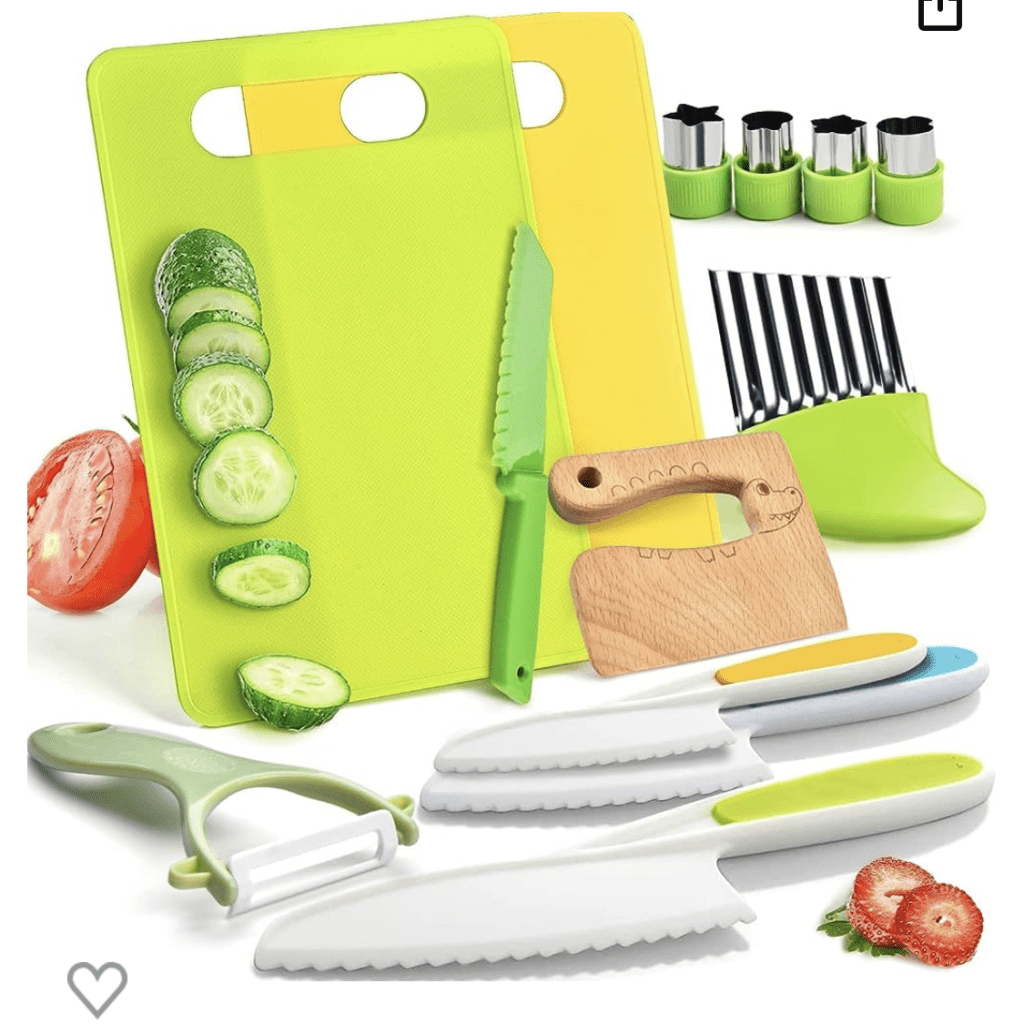
- have your child help you prepare foods! I have the set linked above (and here) from Amazon (affiliate link attached) with a variety of different child safe kitchen tools and cute shape cutters! With the kid I work with, we cut up different foods which allows him to feel them, and we make different shapes – I also work at a farm with animals, so we feed these to animals so he feels like there is a purpose and not a pressure for him to eat. You can also use the same concept in baking – getting your child to mash bananas or cut up apples into small pieces to make muffins for the family!
Tip 2: Try smaller portions
When exploring new food, try introducing a small sample size to make the experience less overwhelming and more inviting to taste! When you are making a meal, have a tiny bowl or plate with some new things for your child to try, or even better have ONE small piece of the food available for them to try! Introducing new foods in large portions can give off the impression that all of it must be eaten which can be very overwhelming. Small portions allow kids to explore, even if just visually at first.

Something I like to suggest is having a plate of the new food added to the table that is visually accessible to your child, but without pressure to have it on their plate. Perhaps this is a tray of carrots beside their favourite (or tolerated) veggie during their favourite pizza dinner. This way they can watch everyone at the table try it, perhaps take one to touch and smell, but still enjoy dinner!
Tip 3: Tune into Textures
Some children are hypersensitive to particular textures rather than the flavour of a particular food, and this is what can lead to an aversion. Now that I am working with children with sensory needs and doing more research and reflection, I know that I am one of these individuals. When I was a kid my mom INSISTED on me eating bananas once a week and it was the worst morning of the week haha! But I truly love banana loaf, banana mixed with kiwi and banana smoothies…. the taste is great it’s the texture I can’t handle! But the beauty of being humans is that we can get creative with food! Try blending, boiling, finely chopping and baking foods they may have enjoyed in the past, in order to change the texture they aren’t comfortable with.
Tip 4: Offer choices and control
I will stand tall on this mountain forever – children need and want choice. As humans, feeling like you have a choice is something we all crave, and children are just younger, inexperienced humans! Offering a broad variety of choices within a particular food category can allow children to explore and choose which food they feel comfortable trying. And remember, you are still in control as the parent if that is your concern – with controlled choice, you are choosing the options available, but still giving your child choice as to what they want to try while still feeling safe that they will be fed and happy.
Tip 5: Be careful with rewards
It is important that you use care around language of encouragement with your child and are reinforcing the willingness to try new foods! Providing rewards such as “you can have a cookie if you eat…” might work a couple times, but your child will not learn to enjoy new foods or understand why it is important to have a well rounded diet. Using language such as “try it for me….” might also work, but lead your child to connecting eating different foods to pleasing others, which doesn’t meet our food goal! OT is always about transferring skills learned to the rest of our clients’ lives. Instead, try using more encouraging language like “You don’t have to eat it if you don’t want to, it’s just to try” or “There are other things on the table to choose from if you’re hungry”. Make trying food fun and a family activity so there are positive connections made with food, instead of making it a means to earning a reward.
It is good to keep in mind that working on food goals can take a long time and requires lots of patience. Think of yourself as a child and who you are now. Are there foods that you fought against as a child and don’t like still as an adult? Or foods you like now but didn’t eat as a child? Your child will work through and find their palate, give them time and the opportunity to explore foods! I have had some parents in the past identify food as a goal for their child, but then never provide me with the foods we needed to explore (i always consider cultural differences and expectations between myself and clients’ families) as well as what is available to families. Extending the practice to home is essential too – if you aren’t exposing your child to food at home and are only relying on your OT to explore food in sessions, the transfer of skill will take a long time!
Take your time, have some fun and explore with your child! Happy eating 🙂
 Be Your Own Sunshine